
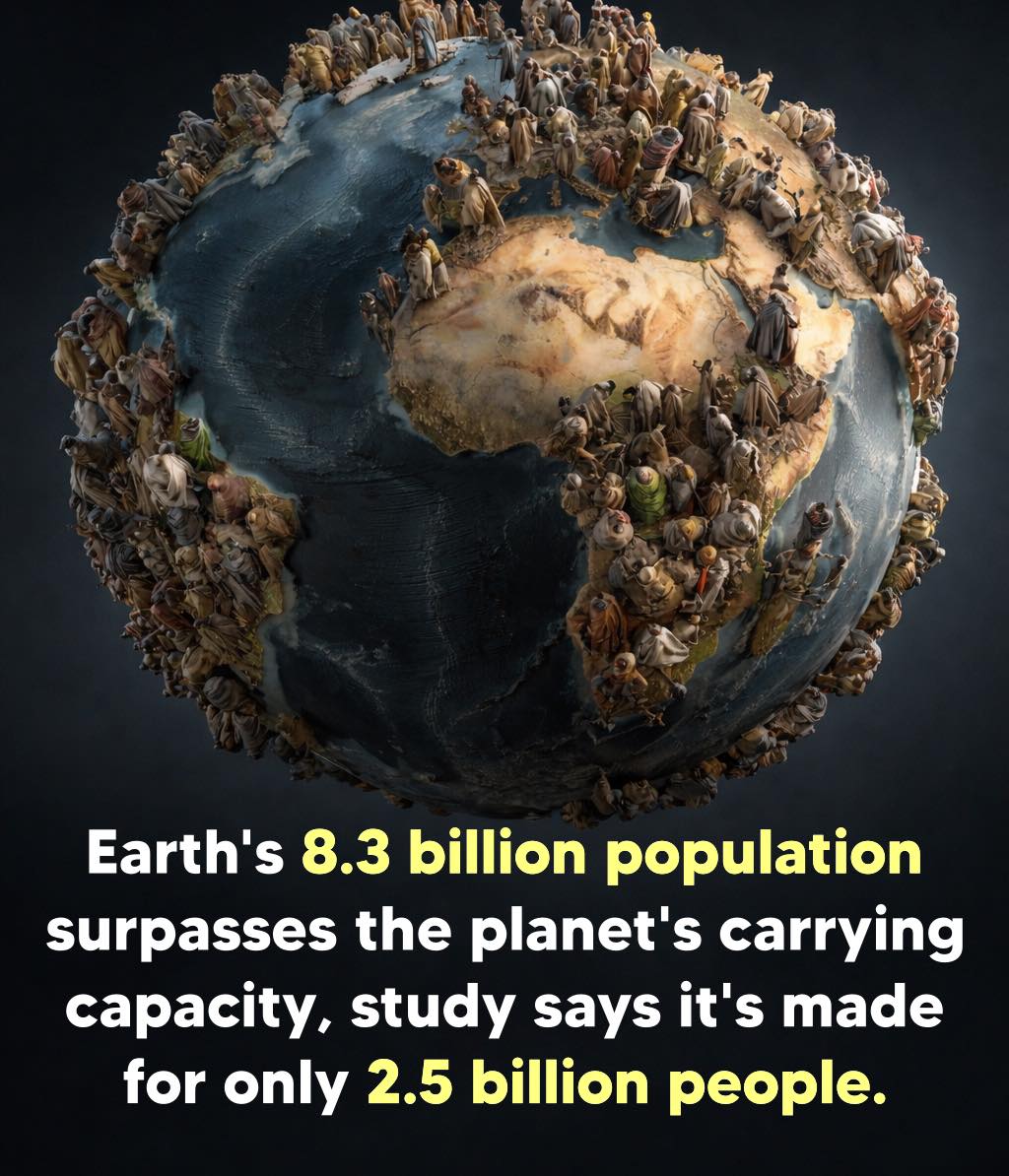
A new study led by Corey Bradshaw from Flinders University suggests that Earth’s current population of around 8.3 billion has already surpassed what the planet can sustainably support at today’s consumption levels.
Carrying capacity—the maximum number of people Earth can support long-term based on resources like food, water, and energy—is estimated in the study to be closer to 2.5 billion, far below current figures.
The research highlights how fossil fuels have temporarily boosted this capacity, allowing rapid population growth while also increasing environmental strain and climate risks.
With global population expected to approach 12 billion, the study warns that without major changes, the pressure on Earth’s systems will continue to intensify.
Carrying capacity—the maximum number of people Earth can support long-term based on resources like food, water, and energy—is estimated in the study to be closer to 2.5 billion, far below current figures.
The research highlights how fossil fuels have temporarily boosted this capacity, allowing rapid population growth while also increasing environmental strain and climate risks.
With global population expected to approach 12 billion, the study warns that without major changes, the pressure on Earth’s systems will continue to intensify.
A new study led by Corey Bradshaw from Flinders University suggests that Earth’s current population of around 8.3 billion has already surpassed what the planet can sustainably support at today’s consumption levels.
Carrying capacity—the maximum number of people Earth can support long-term based on resources like food, water, and energy—is estimated in the study to be closer to 2.5 billion, far below current figures.
The research highlights how fossil fuels have temporarily boosted this capacity, allowing rapid population growth while also increasing environmental strain and climate risks.
With global population expected to approach 12 billion, the study warns that without major changes, the pressure on Earth’s systems will continue to intensify.





 English
 Arabic
 Spanish
 Portuguese
 Deutsch
 Turkish
 Dutch
Dutch
 Italiano
 Russian
 Romaian
 Portuguese (Brazil)
 Greek
Greek