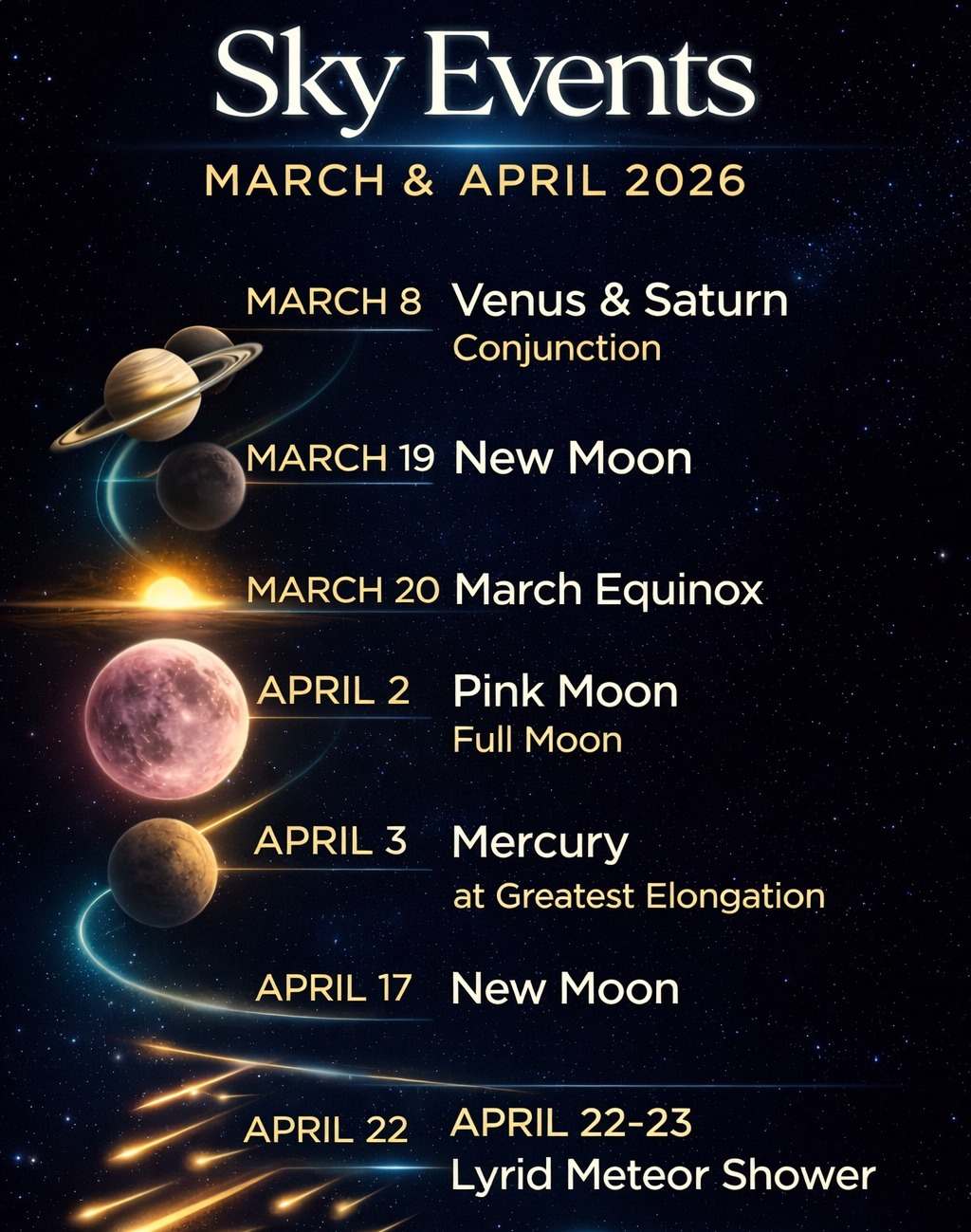
The next few weeks bring beautiful celestial events for skywatchers. If you enjoy stepping outside and looking up, this is a perfect time to keep an eye on the night sky.
March 8 – Venus & Saturn Conjunction
Two bright planets will appear very close together in the evening sky, creating a stunning planetary pairing.
March 19 – New Moon
With the Moon absent from the sky, this will be one of the best nights for stargazing and Milky Way photography.
March 20 – March Equinox
Day and night become nearly equal worldwide, marking the start of astronomical spring in the Northern Hemisphere.
April 2 – Full “Pink” Moon
Despite the name, the Moon won’t actually look pink. The name comes from early spring wildflowers that bloom around this time.
☿ April 3 – Mercury at Greatest Elongation
One of the best chances to spot Mercury, the most elusive planet, shining low in the morning sky.
April 17 – New Moon
Another excellent window for deep-sky observing and astrophotography.
April 22–23 – Lyrid Meteor Shower (Peak)
One of the oldest recorded meteor showers, with shooting stars streaking across the sky before dawn.
Most of these events are visible without special equipment.
Just find a dark spot, give your eyes a few minutes to adjust, and enjoy the universe above.
March 8 – Venus & Saturn Conjunction
Two bright planets will appear very close together in the evening sky, creating a stunning planetary pairing.
March 19 – New Moon
With the Moon absent from the sky, this will be one of the best nights for stargazing and Milky Way photography.
March 20 – March Equinox
Day and night become nearly equal worldwide, marking the start of astronomical spring in the Northern Hemisphere.
April 2 – Full “Pink” Moon
Despite the name, the Moon won’t actually look pink. The name comes from early spring wildflowers that bloom around this time.
☿ April 3 – Mercury at Greatest Elongation
One of the best chances to spot Mercury, the most elusive planet, shining low in the morning sky.
April 17 – New Moon
Another excellent window for deep-sky observing and astrophotography.
April 22–23 – Lyrid Meteor Shower (Peak)
One of the oldest recorded meteor showers, with shooting stars streaking across the sky before dawn.
Most of these events are visible without special equipment.
Just find a dark spot, give your eyes a few minutes to adjust, and enjoy the universe above.
The next few weeks bring beautiful celestial events for skywatchers. If you enjoy stepping outside and looking up, this is a perfect time to keep an eye on the night sky.
March 8 – Venus & Saturn Conjunction
Two bright planets will appear very close together in the evening sky, creating a stunning planetary pairing.
March 19 – New Moon
With the Moon absent from the sky, this will be one of the best nights for stargazing and Milky Way photography.
March 20 – March Equinox
Day and night become nearly equal worldwide, marking the start of astronomical spring in the Northern Hemisphere.
April 2 – Full “Pink” Moon
Despite the name, the Moon won’t actually look pink. The name comes from early spring wildflowers that bloom around this time.
☿ April 3 – Mercury at Greatest Elongation
One of the best chances to spot Mercury, the most elusive planet, shining low in the morning sky.
April 17 – New Moon
Another excellent window for deep-sky observing and astrophotography.
April 22–23 – Lyrid Meteor Shower (Peak)
One of the oldest recorded meteor showers, with shooting stars streaking across the sky before dawn.
Most of these events are visible without special equipment.
Just find a dark spot, give your eyes a few minutes to adjust, and enjoy the universe above.