This Newly Launched Satellite Just 'Bloomed' a Record-Breaking Antenna in Orbit
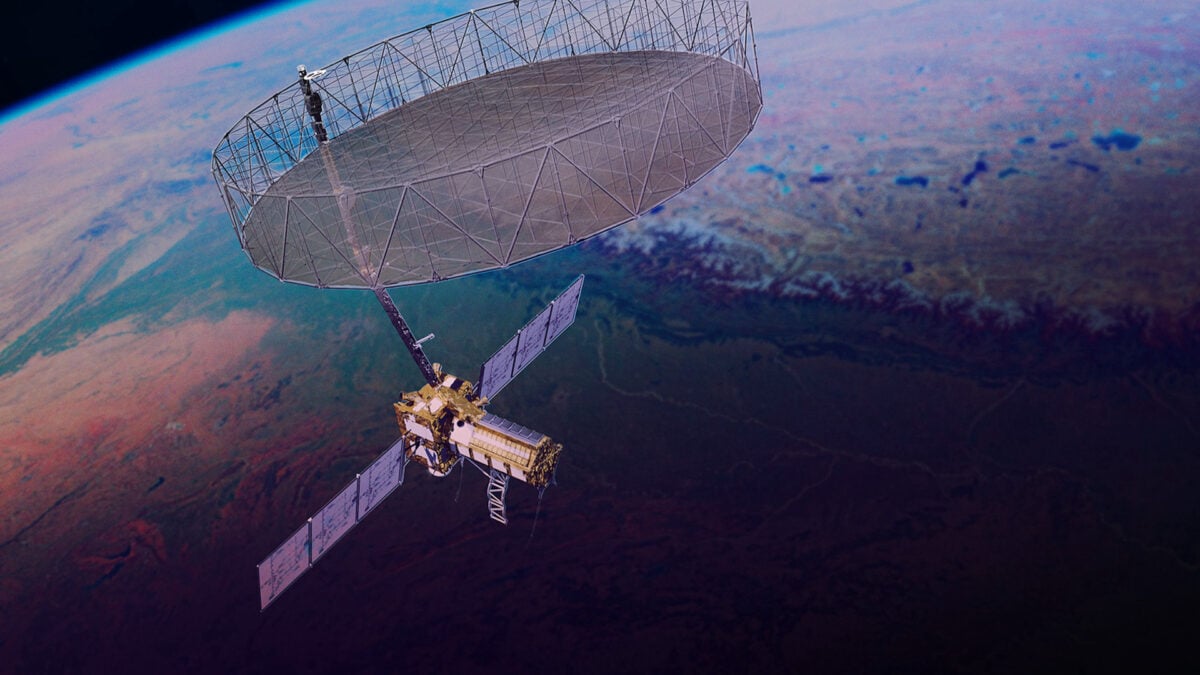
A first-of-its-kind satellite recently launched into orbit to monitor Earth’s changing surfaces, detecting movement of the planet’s crust down to fractions of an inch. The satellite packed a giant radar antenna, folded like an umbrella, and it just unfurled the massive, drum-shaped structure through an intricate process that brought it to full bloom.
The NISAR mission, a joint effort between NASA and the Indian space agency ISRO, launched on July 30 from Satish Dhawan Space Centre in India. More than two weeks later, the satellite deployed its antenna reflector, which spans 39 feet (12 meters) wide—the largest ever used on a NASA mission. The team behind the mission began the process on August 9, unfolding the satellite’s boom one joint at a time and then firing a series of explosive bolts so that it could be deployed and locked into place in space.
“We were of course eager to see the deployment go well. It’s a critical part of the NISAR Earth science mission and has taken years to design, develop, and test to be ready for this big day,” Phil Barela, NISAR project manager at NASA’s Jet Propulsion Laboratory in Southern California, said in a statement. “Now that we’ve launched, we are focusing on fine-tuning it to begin delivering transformative science by late fall of this year.”
NISAR, short for NASA-ISRO Synthetic Aperture Radar, is designed to produce a three-dimensional view of Earth in unprecedented detail. The mission is equipped with the most sophisticated radar system for a NASA mission. The antenna reflector plays a key role for NISAR’s two synthetic aperture radar (SAR) systems, which use the motion of the radar antenna over its targeted area to create high-resolution images.
“Synthetic aperture radar, in principle, works like the lens of a camera, which focuses light to make a sharp image,” Paul Rosen, NISAR’s project scientist at JPL, said in a statement. “The size of the lens, called the aperture, determines the sharpness of the image.” The first radar system, L-band, can see through clouds and forest canopy. The second, an S-band system provided by ISRO, can see through clouds as well but is more sensitive to light vegetation and moisture in snow, according to NASA.
The reflector weighs about 142 pounds (64 kilograms) and comes with a cylindrical frame made of 123 composite struts and a gold-plated wire mesh. At the beginning of the process, NISAR’s boom began unfolding one joint at a time after being tucked in close to the satellite’s body. It took four days for it to become fully extended. On August 15, the team fired a series of small explosive bolts that held the reflector assembly in place to begin what NASA calls the “bloom” process. Through this process, the antenna unfurled by releasing tension stored in its flexible frame while it was tucked away like an umbrella. The team then activated motors and cables that pulled the antenna to its final form, blooming in its full glory.
The reflector is as wide as the length of a school bus, enabling NISAR to image Earth’s surface down to pixels about 30 feet (10 meters) across. “Using special interferometric techniques that compare images over time, NISAR enables researchers and data users to create 3D movies of changes happening on Earth’s surface,” Rosen said.


Kategoriler
Read More
Lương hưu, trợ cấp bảo hiểm xã hội, trợ cấp ưu đãi người có công và trợ cấp xã hội cũng sẽ được điều chỉnh tương ứng. Việc tăng lương cơ sở cũng kéo theo mức thưởng kèm theo Huy hiệu Đảng được điều chỉnh. Căn cứ theo Hướng dẫn 56-HD/VPTW năm 2015, mức tiền thưởng được tính dựa trên hệ số nhân với lương cơ sở Như vậy, với người có huy hiệu 30 năm...

Tham gia BHYT đủ 5 năm liên tục được nhận tiền trợ cấp là lừa đảo Gần đây, BHXH quận Hải Châu nhận được phản ánh của người tham gia BHYT về việc hỗ trợ làm thủ tục xin trợ cấp tiền BHYT thông qua mạng xã hội. Theo đó, ông Nguyên Hoàng Tân, phường Hòa Minh (quận Liên Chiểu) đến cơ quan BHXH quận Hải Châu trình bày có một người trên mạng xã hội liên hệ...

Những điều kiện để được mua bán nhà đất Khoản 1 Điều 45 Luật Đất đai 2024 quy định người chuyển nhượng, tặng cho quyền sử dụng đất thông thường phải có đủ 5 điều kiện. Thứ nhất là có giấy chứng nhận quyền sử dụng đất, quyền sở hữu tài sản gắn liền với đất. Bên cạnh đó với giao dịch mua bán nhà ở, Khoản 2 Điều 160 Luật Nhà ở 2023 quy định có 5 trường...
Từ 1/7/2025, Trưởng thôn, Tổ trưởng tổ dân phố được hưởng phụ cấp hàng tháng mức cao nhất bằng 6,0 lần mức lương cơ sở. Trong đó, có thể hiểu Trưởng thôn, Tổ trưởng tổ dân phố là những người hoạt động không chuyên trách ở thôn, tổ dân phố, được hưởng phụ cấp hàng tháng, mức phụ cấp do Hội đồng nhân dân cấp tỉnh quyết định theo quy định của pháp luật....

Những trường hợp bị thu hồi đăng ký xe và biển số xe Trước ngày 1/1/2026, người dân mua xe máy cũ không sang tên bị CSGT thu hồi Đăng ký xe, đúng không? (Ảnh minh hoạ) Cụ thể, 8 trường hợp thu hồi biển số xe được quy định tại Điều 23 Thông tư 24/2023/TT-BCA của Bộ Công an gồm: 1- Những trường hợp xe hỏng không sử dụng được, bị phá hủy do nguyên...