


New Details Emerge About Ancient Inca Counting Technology
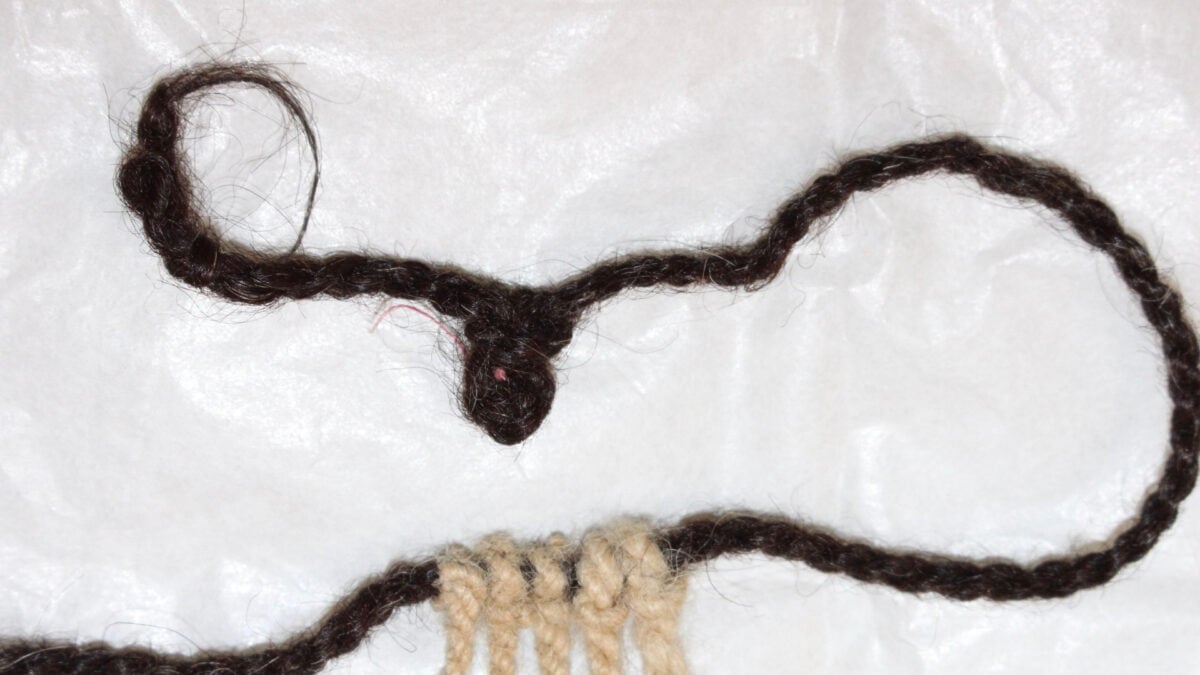
The Inca were a pre-Columbian civilization whose empire sprawled along South America’s Pacific Coast from the 15th to the 16th century CE. Like other Andean peoples, they used khipus (also known as quipus), an intricate cord and knot system used to record information. According to Spanish colonial-era sources, only male Inca elites could make khipus. A new study, however, challenges this widespread notion.
In a paper published today in Science Advances, an international team of researchers investigated the primary cord of a khipu from around 1498 CE made from human hair. Their analysis revealed that the individual who wove their hair into the khipu ate a diet commonly associated with commoners, suggesting that a greater diversity of people used the instrument than previously thought.
“Despite recent advances in our understanding of Andean khipus, scholars know little about the specialists who created Inka khipus,” the researchers wrote in the study. “With limited direct evidence concerning the lives of Inka khipu experts, our knowledge is based mainly on the chronicles of Spanish-language colonial observers.”

Researchers believe that khipus were buried alongside their owners when they died. Unfortunately, however, the burials where experts have discovered many Inca khipus were previously looted, meaning they can no longer provide this crucial insight. As such, the team from the new study took a different approach.
“Historically, when human hair was incorporated into a khipu’s primary cord, it served as a ‘signature’ to indicate the person who created the khipu,” the researchers explained. “Recent advances in elemental analysis–isotope ratio mass spectrometry allowed us to undertake simultaneous carbon (C), nitrogen (N), and sulfur (S) measurements from a single KH0631 hair sample, revealing that this individual consumed a diet characteristic of low-ranking commoners,” they added. “This evidence suggests that Inka commoners could be involved in creating Inka-style khipus.”
Specifically, the individual in question ate tubers and greens instead of meat and corn, which was the typical Inca elite’s diet. The researchers’ approach also revealed that this khipu specialist, or khipukamayuqs, probably lived in modern-day southern Peru or northern Chile.
These results align with the fact that in the 19th and 20th centuries, “commoners,” such as peasant farmers, farm laborers, and female peasants, created and used khipus. What’s more, it bolsters recent research as well as accounts by Felipe Guamán Poma de Ayala, a 16th-century Inca nobleman and chronicler, that women in the Inca Empire also made khipus.
While the researchers admit that “KH0631 is only one khipu,” they conclude that “the new isotopic evidence from KH0631 suggests that khipu literacy in the Inca Empire may have been more inclusive and widespread than hitherto thought.”


Kategorien
Mehr lesen
Từ 01/01/2025, Luật bảo hiểm y tế (BHYT) năm 2024 và Nghị định số 02/2025/NĐ-CP có hiệu lực nên mức hưởng BHYT cũng có sự điều chỉnh. Theo đó, Điều 22 Luật BHYT năm 2024 quy định chi tiết về mức hưởng BHYT của người tham gia. Điểm a Khoản 1 Điều 22 quy định về nhóm được hưởng quyền lợi BHYT cao nhất. Người thuộc nhóm này được hưởng 2 quyền lợi BHYT...

Điện thoại di động cho phép chúng ta làm nhiều điều mà trước đây chúng ta chưa từng nghĩ đến. Đặt đồ ăn, gọi taxi, thanh toán hóa đơn, mua sắm, v.v. đã trở thành một phần trong cuộc sống hàng ngày của chúng ta. Mỗi chiếc điện thoại di động tương ứng với một hoặc hai số điện thoại. Bạn đã bao giờ thấy ai đó không đổi số điện thoại trong hơn 10 năm, thậm...
Microsoft’s much-maligned Recall feature, which automatically screenshots everything you do on your Copilot+ PC to create a “photographic memory,” is not making many fans across the app developer community. According to a report from The Verge, ad blocker AdGuard and privacy-minded browser Brave have decided to block Recall and its prying eyes....

Được chi trả 100% chi phí khám chữa bệnh trong nhiều trường hợp, kể cả trái tuyến Một trong những điểm mới quan trọng của Luật BHYT sửa đổi là người tham gia BHYT từ 5 năm liên tục trở lên sẽ được quỹ BHYT thanh toán toàn bộ chi phí khám chữa bệnh nếu tổng số tiền cùng chi trả trong năm vượt quá 6 lần mức tham chiếu (mức do Chính phủ quy định, thay...
Gần đây, một bài viết lan truyền trên mạng xã hội Trung Quốc với nội dung: "Đừng giặt quần lót bằng tay, hậu quả đáng sợ…" đã thu hút sự chú ý của cộng đồng mạng. Nhiều người bày tỏ sự bất ngờ và phản biện: "Giặt tay mà còn dư chất tẩy là do xả chưa sạch", hay "Không giặt tay mà cho vào máy giặt thì chẳng phải còn bẩn hơn sao?". Trước tranh cãi này,...
