New Brain Interface Interprets Inner Monologues With Startling Accuracy
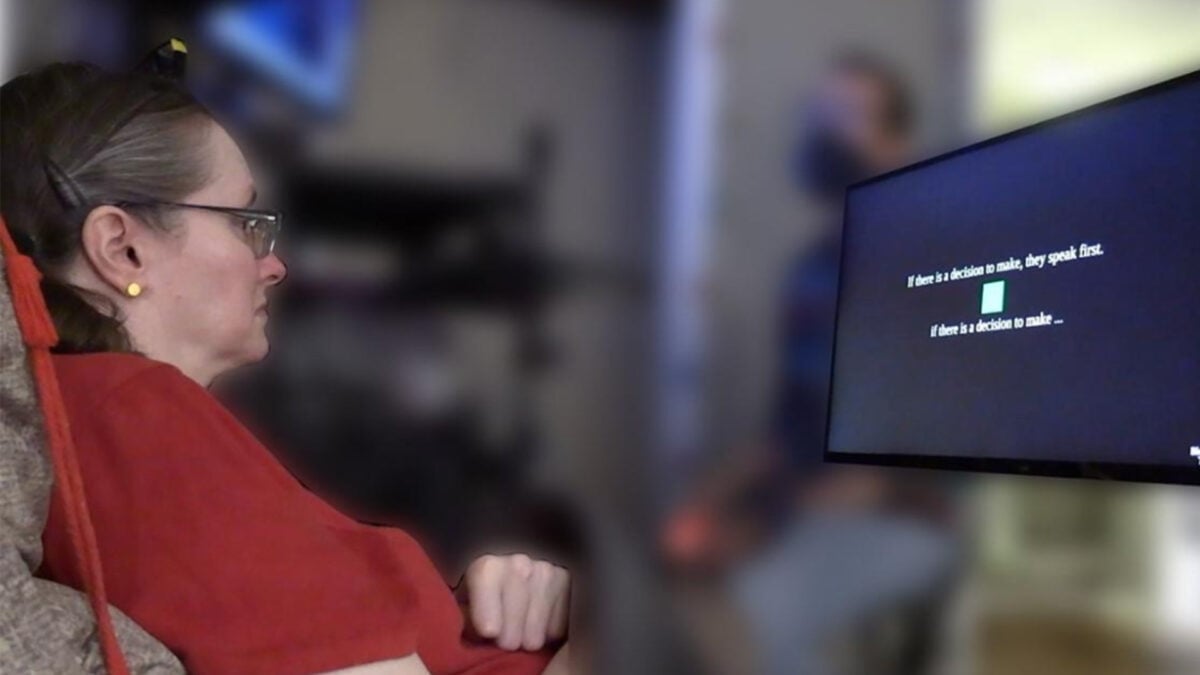
Scientists can now decipher brain activity related to the silent inner monologue in people’s heads with up to 74% accuracy, according to a new study.
In new research published today in Cell, scientists from Stanford University decoded imagined words from four participants with severe paralysis due to ALS or brainstem stroke. Aside from being absolutely wild, the findings could help people who are unable to speak communicate more easily using brain-computer interfaces (BCIs), the researchers say.
“This is the first time we’ve managed to understand what brain activity looks like when you just think about speaking,” lead author Erin Kunz, a graduate student in electrical engineering at Stanford University, said in a statement. “For people with severe speech and motor impairments, BCIs capable of decoding inner speech could help them communicate much more easily and more naturally.”
Previously, scientists have managed to decode attempted speech using BCIs. When people physically attempt to speak out loud by engaging the muscles related to speech, these technologies can interpret the resulting brain activity and type out what they’re trying to say. But while effective, the current methods of BCI-assisted communication can still be exhausting for people with limited muscle control. The new study is the first to directly take on inner speech.
To do so, the researchers recorded activity in the motor cortex—the region responsible for controlling voluntary movements, including speech—using microelectrodes implanted in the motor cortex of the four participants.
The researchers found that attempted and imagined speech activate similar, though not identical, patterns of brain activity. They trained an AI model to interpret these imagined speech signals, decoding sentences from a vocabulary of up to 125,000 words with as much as 74% accuracy. In some cases, the system even picked up unprompted inner thoughts, like numbers participants silently counted during a task.
For people who want to use the new technology but don’t always want their inner thoughts on full blast, the team added a password-controlled mechanism that prevented the BCI from decoding inner speech unless the participants thought of a password (“chitty chitty bang bang” in this case). The system recognized the password with more than 98% accuracy.
While 74% accuracy is high, the current technology still makes a substantial amount of errors. But the researchers are hopeful that soon, more sensitive recording devices and better algorithms could boost their performance even more.
“The future of BCIs is bright,” Frank Willett, assistant professor in the department of neurosurgery at Stanford and the study’s lead author, said in a statement. “This work gives real hope that speech BCIs can one day restore communication that is as fluent, natural, and comfortable as conversational speech.”


Kategoriler
Read More
Có nhiều bệnh nhân, mặc dù họ bị bệnh phổi nhưng phổi của họ không có các triệu chứng điển hình Mới đây, trang Thanh Niên Việt đăng tải bài viết với tựa đề "Phổi có tốt hay không, chỉ cần nhìn vào bàn tay: Người có phổi kém thường có 5 bất thường ở tay, hãy xem bạn có không" có nội dung như sau: Mặc dù nhiều bệnh nhân mắc bệnh phổi sẽ có các triệu chứng điển hình như ho, khó thở hay đau ngực,...

Sáng ngày 12/6, với 461/465 đại biểu có mặt tán thành, Quốc hội đã chính thức thông qua Nghị quyết sắp xếp đơn vị hành chính cấp tỉnh. Nghị quyết này chính thức có hiệu lực từ ngày 12/6/2025. Như vậy, TP.HCM chính thức hợp nhất với tỉnh Bình Dương và tỉnh Bà Rịa - Vũng Tàu, lấy tên gọi chung là TP.HCM. Sáng 28/6, Tập đoàn Bcons tổ chức lễ khởi công dự...

Những năm 1990, Thạch Thảo là một trong những nữ ca sĩ quen thuộc trong các sản phẩm âm nhạc mang tên Mưa bụi . Nữ ca sĩ tài sắc vẹn toàn, sở hữu giọng ca ngọt ngào đi vào lòng người. Không ít người thời đó còn ví cô là "mỹ nhân Mưa bụi" hay "mỹ nhân bolero ". Không quá đình đám như các nghệ sĩ cùng thời, nhưng cô lại được đánh giá cao bởi giọng hát...

President Donald Trump angered his own supporters recently when his U.S. Department of Justice said it wouldn’t be releasing any more information about the late sex offender Jeffrey Epstein. But after days of outrage, including from the Deputy Director of the FBI, Dan Bongino, Trump is now signaling that Attorney General Pam Bondi might release...

Đã có ePass, VETC vì sao phải chuyển đổi sang tài khoản giao thông? Nghị định 119 của Chính phủ quy định về thanh toán điện tử giao thông đường bộ (có hiệu lực từ 1/10/2024), để trả phí đường bộ qua trạm thu phí theo hình thức thu phí điện tử không dừng (ETC). Theo đó, chủ xe cần mở tài khoản giao thông kết nối với một phương tiện thanh toán không...