


Newly Discovered Fossils Reveal Unknown Humanlike Relative
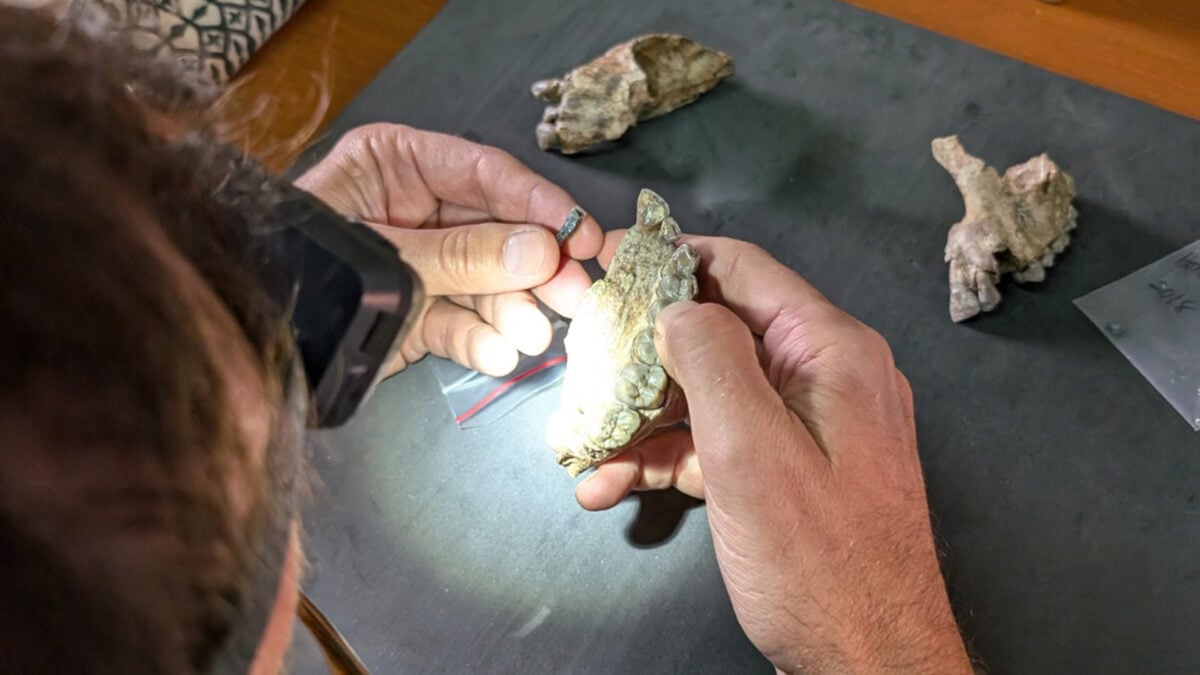
Researchers have uncovered fossils belonging to a previously unknown ancient human relative. And they may have lived in the same time and place as the earliest-known members of the genus Homo, from which modern humans evolved, according to a new study.
A team of archeologists working at Ethiopia’s Ledi-Geraru research project area unearthed a set of fossilized teeth that likely belonged to an unidentified species within the Australopithecus genus, known for having both human- and ape-like traits. The findings are published in Nature.
Until now, scientists have discovered six Australopithecus species in sites in Africa, including the famous Lucy fossil. But not all of these species intersected with our earliest human ancestors in the genus Homo.
The newly found teeth, from two individuals, date back 2.6 to 2.8 million years. While they share some characteristics with other Australopithecus species, comparisons with nearby fossils and other hominin specimens indicate they are distinct enough to be considered a new species.
At the same site, the scientists also discovered three other teeth that likely belonged to members of the earliest species of Homo, dating to 2.59 million years ago. That species was first identified in 2013 through a jawbone at the same study site.
These discoveries suggest that as many as four early human-like lineages—Homo, Paranthropus, Australopithecus garhi, and the newly identified species—may have coexisted in East Africa between 2.5 and 3.0 million years ago.
“This new research shows that the image many of us have in our minds of an ape to a Neanderthal to a modern human is not correct—evolution doesn’t work like that,” Kaye Reed, a paleoecologist at Arizona State University, said in a statement. “Here we have two hominin species that are together. And human evolution is not linear, it’s a bushy tree, there are lifeforms that go extinct.”
The researchers need more fossils from the species to officially give it a name. But for now, the researchers have dubbed the new genus Ledi-Geraru Australopithecus.
How these early ancestors were able to coexist is still a mystery, but it’s possible that they ate different things and weren’t competing for the same resources. The scientists are currently examining the enamel of the newly discovered teeth to figure out what these species may have eaten.
“Whenever you have an exciting discovery, if you’re a paleontologist, you always know that you need more information,” Reed said in a statement. “You need more fossils. That’s why it’s an important field to train people in and for people to go out and find their own sites and find places that we haven’t found fossils yet.”


Categories
Read More
Ban quản trị nhà chung cư không lập hóa đơn khi cung cấp dịch vụ cho cư dân thì bị xử lý như thế nào? Căn cứ theo điểm c khoản 1 Điều 17 Nghị định 125/2020/NĐ-CP có quy định như sau: Xử phạt hành vi trốn thuế 1. Phạt tiền 1 lần số thuế trốn đối với người nộp thuế có từ một tình tiết giảm nhẹ trở lên khi thực hiện một trong các hành vi vi phạm sau...

Theo khoản 1 Điều 257 Luật Đất đai 2024 thì từ ngày 1.1.2026, các tỉnh, thành phố trực thuộc Trung ương sẽ ban hành và áp dụng bảng giá đất mới. Sau đó, hằng năm sẽ điều chỉnh, sửa đổi, bổ sung bảng giá đất (cập nhật giá đất cho phù hợp với thị trường đối với những khu vực, loại đất có biến động) thay vì định kỳ 5 năm/lần như hiện nay để phù hợp với...

Tách thửa đất là thủ tục nhằm phân chia quyền sử dụng đất và quyền sở hữu tài sản gắn liền với đất thành nhiều phần khác nhau. Hợp thửa đất là việc gộp nhiều thửa đất liền kề của cùng một người sử dụng thành một thửa đất có quyền sử dụng chung. Ngày 23/6/2025, Bộ Nông nghiệp và Môi trường ban hành Quyết định số 2304/QĐ-BNNMT về việc công bố thủ tục...

Google’s slop machine, Veo 3, is already firmly at the center of our brave new world of generative video, and it seems to have its sights trained on YouTube content in particular. There are Harry Potter vlogs, man-on-the-street content, unboxings, and now, the slop cannon is pointed straight at another pillar of YouTube, and this one has me ready to...

Vào ngày 25/6, Quốc hội đã thông qua Luật sửa đổi, bổ sung một số điều của Bộ luật Hình sự. Luật có hiệu lực thi hành kể từ 1/7. Theo Bộ luật Hình sự có 10 tội danh còn hình phạt cao nhất là tử hình, từ 1/7, bao gồm: - Phản bội Tổ quốc (điều 108). - Bạo loạn (điều 112). - Khủng bố nhằm chống chính quyền nhân dân (điều 113). - Giết người (điều...
