


Newly Discovered Fossils Reveal Unknown Humanlike Relative
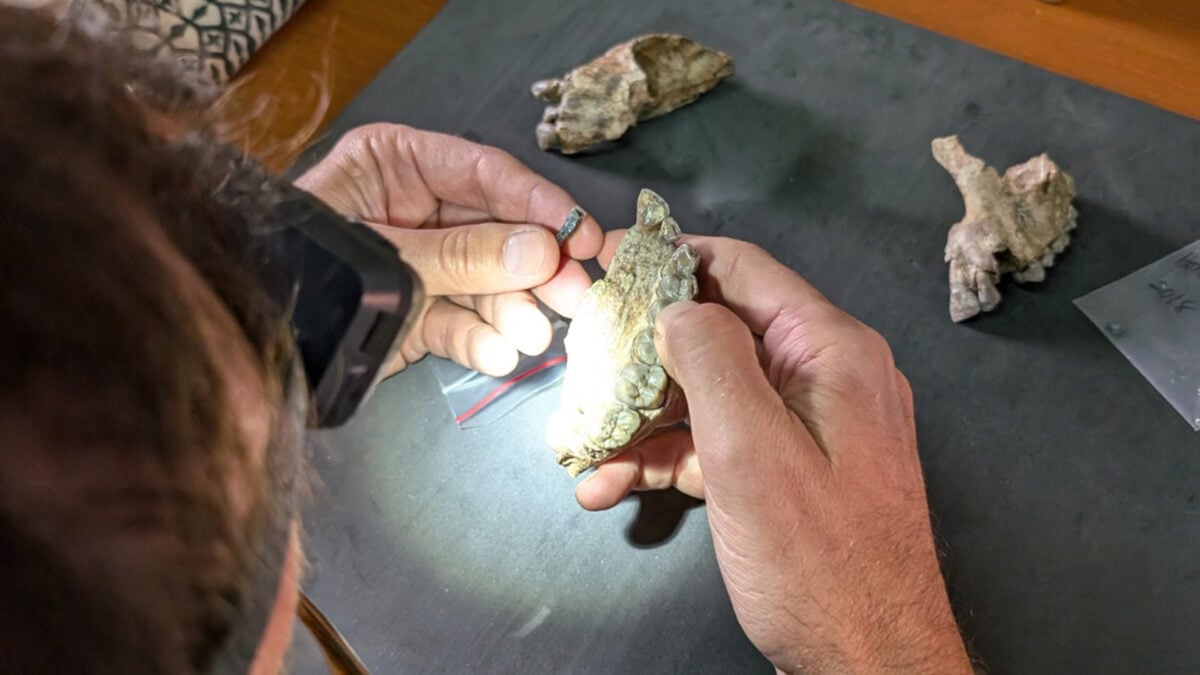
Researchers have uncovered fossils belonging to a previously unknown ancient human relative. And they may have lived in the same time and place as the earliest-known members of the genus Homo, from which modern humans evolved, according to a new study.
A team of archeologists working at Ethiopia’s Ledi-Geraru research project area unearthed a set of fossilized teeth that likely belonged to an unidentified species within the Australopithecus genus, known for having both human- and ape-like traits. The findings are published in Nature.
Until now, scientists have discovered six Australopithecus species in sites in Africa, including the famous Lucy fossil. But not all of these species intersected with our earliest human ancestors in the genus Homo.
The newly found teeth, from two individuals, date back 2.6 to 2.8 million years. While they share some characteristics with other Australopithecus species, comparisons with nearby fossils and other hominin specimens indicate they are distinct enough to be considered a new species.
At the same site, the scientists also discovered three other teeth that likely belonged to members of the earliest species of Homo, dating to 2.59 million years ago. That species was first identified in 2013 through a jawbone at the same study site.
These discoveries suggest that as many as four early human-like lineages—Homo, Paranthropus, Australopithecus garhi, and the newly identified species—may have coexisted in East Africa between 2.5 and 3.0 million years ago.
“This new research shows that the image many of us have in our minds of an ape to a Neanderthal to a modern human is not correct—evolution doesn’t work like that,” Kaye Reed, a paleoecologist at Arizona State University, said in a statement. “Here we have two hominin species that are together. And human evolution is not linear, it’s a bushy tree, there are lifeforms that go extinct.”
The researchers need more fossils from the species to officially give it a name. But for now, the researchers have dubbed the new genus Ledi-Geraru Australopithecus.
How these early ancestors were able to coexist is still a mystery, but it’s possible that they ate different things and weren’t competing for the same resources. The scientists are currently examining the enamel of the newly discovered teeth to figure out what these species may have eaten.
“Whenever you have an exciting discovery, if you’re a paleontologist, you always know that you need more information,” Reed said in a statement. “You need more fossils. That’s why it’s an important field to train people in and for people to go out and find their own sites and find places that we haven’t found fossils yet.”


Kategoriler
Read More
Ngành Kinh tế xây dựng chính Trong bối cảnh nền kinh tế đang phát triển nhanh chóng cùng với quá trình đô thị hóa diễn ra mạnh mẽ, ngành Kinh tế xây dựng đang nổi lên như một lựa chọn hấp dẫn nhưng lại ít người lựa chọn. Đây là ngành học đặc thù, kết hợp giữa kiến thức về kinh tế, tài chính và kỹ thuật xây dựng, nhằm tối ưu hóa chi phí và hiệu quả của...

Ngay ngày thứ hai đi làm, Tiểu Lý được các đồng nghiệp mời đi ăn trưa và trong bữa ăn, một người đã khéo léo dò hỏi: “Cậu mới vào chắc cũng được hơn 5 triệu nhỉ?”. Với sự thật thà, anh không ngần ngại trả lời: “Hơn 5 triệu một chút.” Không khí bàn ăn lập tức chùng xuống. Sau bữa đó, Tiểu Lý cảm thấy thái độ của đồng nghiệp với mình có phần lạnh nhạt,...

Trong bối cảnh kinh tế toàn cầu khởi sắc, ngành du lịch Việt Nam đang ghi dấu ấn mạnh mẽ với tốc độ phục hồi ấn tượng sau đại dịch. Không chỉ đóng góp lớn vào GDP, lĩnh vực này còn tạo ra hàng triệu cơ hội việc làm, đặc biệt hấp dẫn giới trẻ. Theo Cục Du lịch quốc gia, năm 2025 ngành dự kiến đón 18 triệu lượt khách quốc tế và cần đến 5,5 triệu lao...

Trong khi phẫu thuật thẩm mỹ đã trở thành xu hướng phổ biến tại Hàn Quốc, đặc biệt trong giới trẻ và người nổi tiếng, thì nghi vấn về nhan sắc thật – đặc biệt là vòng một – vẫn luôn là đề tài gây tranh cãi. Tuy nhiên, thay vì né tránh như nhiều người khác, nữ streamer xinh đẹp Yeoam lại chọn cách đối mặt trực diện. Không chỉ phản bác bằng lời nói, cô nàng còn khiến cộng đồng mạng...

Trong cộng đồng yêu thích cosplay, Shiroi - gương mặt nổi bật với gần 20.000 người theo dõi chiếm sự yêu mến của người hâm mộ với phong cách dễ thương, duyên dáng và một hình ảnh trong sáng, thanh thuần....
