Newly Discovered Fossils Reveal Unknown Humanlike Relative
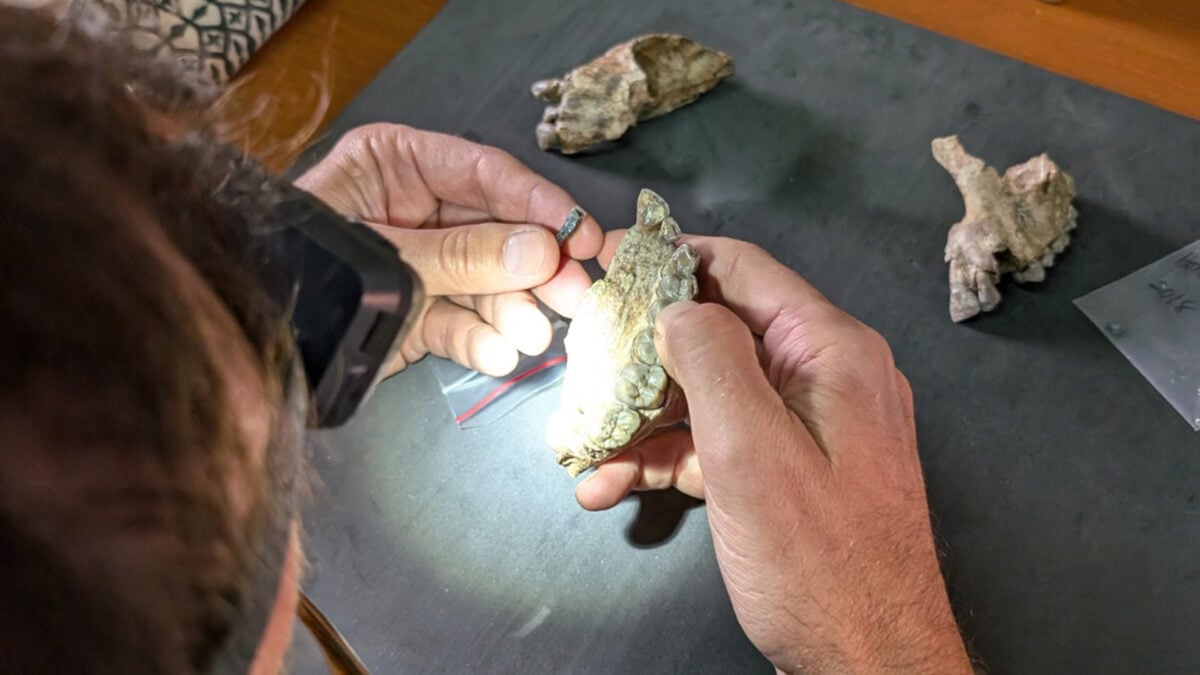
Researchers have uncovered fossils belonging to a previously unknown ancient human relative. And they may have lived in the same time and place as the earliest-known members of the genus Homo, from which modern humans evolved, according to a new study.
A team of archeologists working at Ethiopia’s Ledi-Geraru research project area unearthed a set of fossilized teeth that likely belonged to an unidentified species within the Australopithecus genus, known for having both human- and ape-like traits. The findings are published in Nature.
Until now, scientists have discovered six Australopithecus species in sites in Africa, including the famous Lucy fossil. But not all of these species intersected with our earliest human ancestors in the genus Homo.
The newly found teeth, from two individuals, date back 2.6 to 2.8 million years. While they share some characteristics with other Australopithecus species, comparisons with nearby fossils and other hominin specimens indicate they are distinct enough to be considered a new species.
At the same site, the scientists also discovered three other teeth that likely belonged to members of the earliest species of Homo, dating to 2.59 million years ago. That species was first identified in 2013 through a jawbone at the same study site.
These discoveries suggest that as many as four early human-like lineages—Homo, Paranthropus, Australopithecus garhi, and the newly identified species—may have coexisted in East Africa between 2.5 and 3.0 million years ago.
“This new research shows that the image many of us have in our minds of an ape to a Neanderthal to a modern human is not correct—evolution doesn’t work like that,” Kaye Reed, a paleoecologist at Arizona State University, said in a statement. “Here we have two hominin species that are together. And human evolution is not linear, it’s a bushy tree, there are lifeforms that go extinct.”
The researchers need more fossils from the species to officially give it a name. But for now, the researchers have dubbed the new genus Ledi-Geraru Australopithecus.
How these early ancestors were able to coexist is still a mystery, but it’s possible that they ate different things and weren’t competing for the same resources. The scientists are currently examining the enamel of the newly discovered teeth to figure out what these species may have eaten.
“Whenever you have an exciting discovery, if you’re a paleontologist, you always know that you need more information,” Reed said in a statement. “You need more fossils. That’s why it’s an important field to train people in and for people to go out and find their own sites and find places that we haven’t found fossils yet.”


Categorias
Leia mais
Slow Cooker Buffalo Chicken Dip Ingredients:2 boneless, skinless chicken breasts1 small yellow onion, sliced into 1-inch rounds1/4 cup chicken bone broth or chicken broth8 ounces cream cheese, sliced into 4 cubes3/4 cup ranch dressing1/4 cup hot sauce (adjust to taste)1/2 cup shredded sharp cheddar cheese1/2 cup shredded mozzarella cheeseInstructions:Prepare the Slow Cooker:Place the...

Dự án Vành đai 1 có tổng mức đầu tư gần 7.200 tỉ đồng, trong đó chi phí xây dựng khoảng 627 tỉ đồng, nhưng chi phí giải phóng mặt bằng lên tới hơn 5.818 tỉ đồng. Đây là con số khiến tuyến đường được mệnh danh “con đường đắt nhất hành tinh”. Cầu vượt được xây dựng sẽ giải quyết vấn đề ùn tắc giao thông Trên tuyến đường Vành đai 1 (đoạn Hoàng Cầu - Voi...

For over a decade, Bitcoin has been the undisputed face of digital finance. When you think “crypto,” you think Bitcoin. Its surges and crashes have been treated as bellwethers for the entire industry. This year, it even set new records, solidifying its reign. But for the past month, the crypto world hasn’t been talking about Bitcoin. The spotlight...

Có những trường hợp dù dùng số điện thoại chính chủ nhưng vẫn bị khóa SIM, thu hồi số, người dùng nên biết: Sử dụng SIM cho mục đích lừa đảo, vi phạm pháp luật Có một số kẻ xấu sử dụng nhiều SIM điện thoại để lừa đảo, phát tán thông tin sai sự thật hoặc vi phạm pháp luật sẽ bị xử lý nghiêm khắc. Trong những trường hợp này nhà mạng sẽ phối hợp với cơ...

An experimental “off-the-shelf” vaccine for recurring pancreatic and colorectal cancer is showing great promise so far. Early results show that the vaccine appears to be safe and is potentially prolonging people’s lives. Researchers at the University of California, Los Angeles, the Memorial Sloan Kettering Cancer Center in New York, and elsewhere...